Monday Morning Report Review: How Austin Trades Audit Every Call and Lead in 10 Minutes
If you run a small crew in Austin, TX, your week starts before the coffee kicks in. Trucks need loading, the schedule has gaps, and somewhere in your phone sits a weekend's worth of calls you never heard ring. A Monday morning weekly call report review fixes that problem in one sitting. Instead of scrolling voicemail and guessing which numbers matter, you open a single summary that shows every call your AI receptionist answered, every lead it captured, and every appointment it booked while you were on site or off the clock.
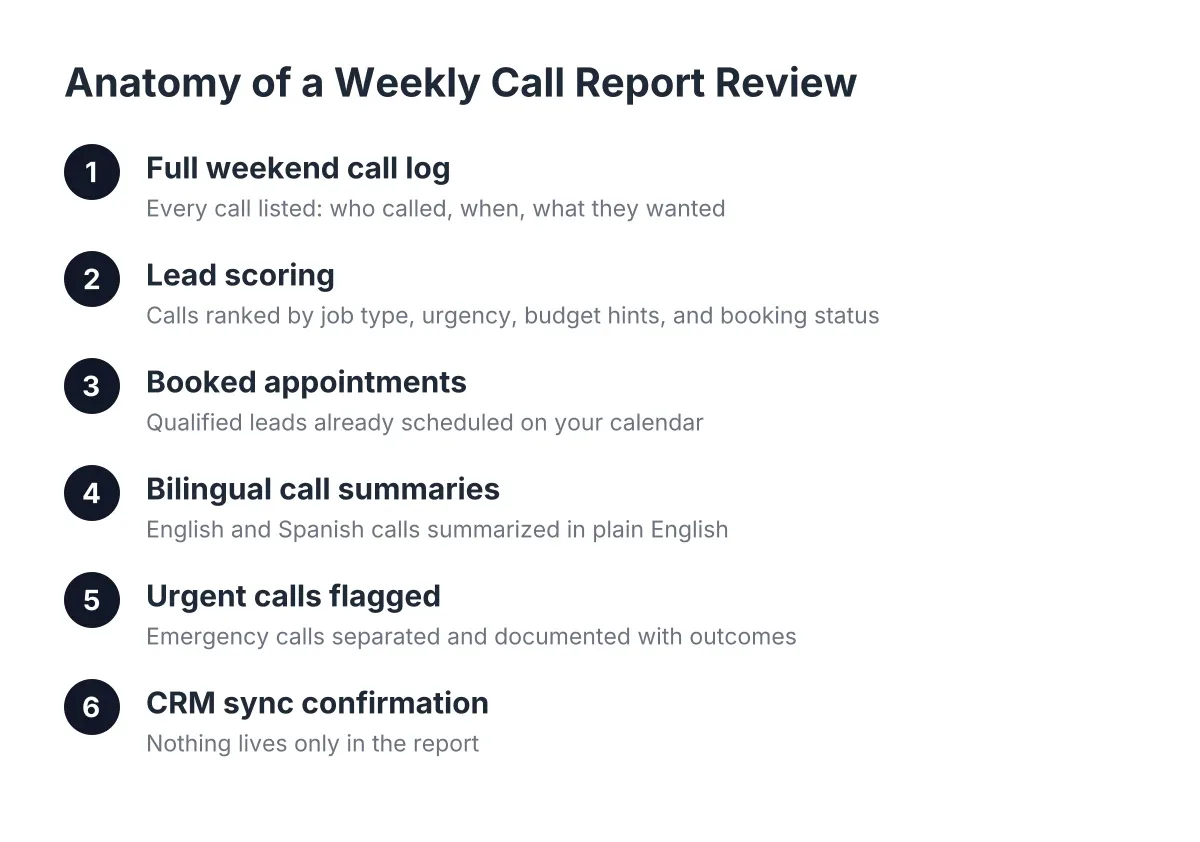
This article walks through exactly what that review looks like in practice, written by the team that built the system for Central Texas trades, not a national call center. Here are eight things a weekly call report review should cover, and what each one tells you about the health of your business.
1. Every Call Answered Over the Weekend, Listed in One Place
The first section of a Monday morning report review is the full call log: who called, when, what they wanted, and what happened next. No digging through your phone's recent calls, no replaying voicemails at half speed while you drive to the first job.
For a general construction or multi-trade operation, weekend calls are a mixed bag. A homeowner in Pflugerville wants a quote on a bathroom remodel. A property manager in Round Rock has a fence down after Saturday's storm. Additionally, a recurring customer in Cedar Park needs a handyman visit. The report separates all of them so you can see your whole weekend in about two minutes.
That matters because speed decides who wins the job. According to MIT Sloan School of Management / InsideSales.com, the odds of contacting a lead drop 100-fold when the callback happens at 30 minutes instead of within 5 minutes. Your AI receptionist answers at the first ring, so the lead is already captured; the Monday report tells you which conversations still need your voice.
2. Lead Scores That Tell You Who to Call Back First
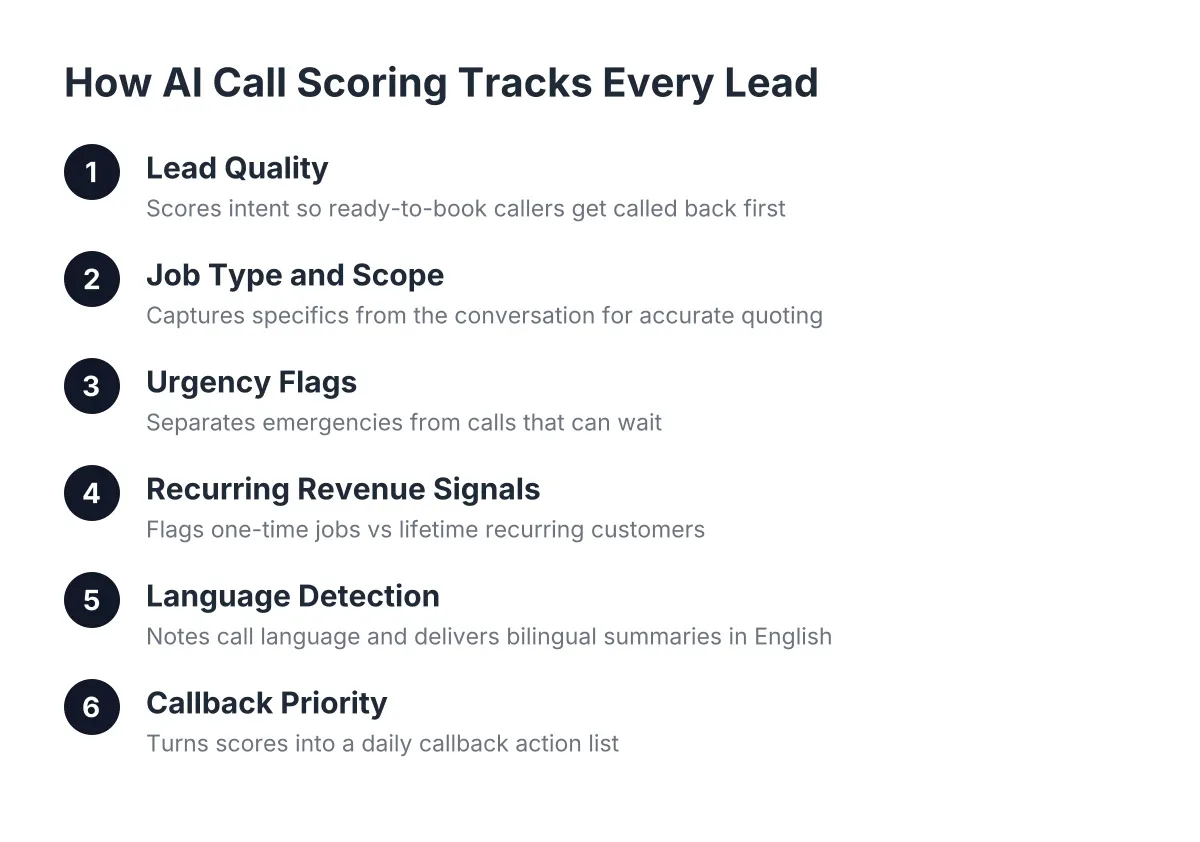
A good report does not treat all calls equally. AI call intelligence scores each lead on signals like job type, urgency, budget hints, and whether the caller booked. Your Monday review starts at the top of that ranked list, not at the bottom of a voicemail queue.
Suppose a typical crew comes back to 14 weekend calls. Four are solid project leads, three are existing customers with small requests, two are suppliers, and five are spam or wrong numbers. Without scoring, you spend 45 minutes sorting that yourself. With scoring, the report hands you the four project leads first, each with a one-paragraph summary of what the caller said.
That is the difference between a Monday that starts with revenue and a Monday that starts with admin work.
3. Appointments Already Booked, So Your Week Fills Itself
The next section shows what got booked while you were gone. When the AI receptionist qualifies a caller, it sends a booking link and confirms the slot, so some leads arrive on Monday already on your calendar.
For example, say a Georgetown homeowner calls Saturday at 7 p.m. about a deck repair. The AI answers, asks about the scope, captures the address and photos request, and sends the booking link. By your Monday morning report review, that estimate is sitting on Wednesday's calendar with the caller's details attached. You did nothing except show up.
This is the part owners underestimate. The value is not just that calls got answered; it is that the week's schedule started building itself two days before you looked at it.
4. Bilingual Call Summaries in Plain English, Every Time
Austin is a bilingual market, and your report should reflect that without extra work on your end. Every plan handles English and Spanish on the same line, and the AI switches languages based on how the caller speaks. The Monday report summarizes every conversation in English regardless of the language of the call.
In practice, that means a Spanish-speaking caller asking about drywall repair in Leander gets a full conversation in Spanish, a booking link, and the same qualification questions as any other caller. You read the summary Monday and call back knowing exactly what they need. No missed context, no awkward callbacks, no leads lost to a language gap.
5. Urgent Calls Flagged Separately From Everything Else
Multi-trade work means some calls cannot wait for Monday. A burst pipe, a roof leak during a storm, a door that will not lock. The report review should show you which calls were flagged urgent and what happened with each one.
With live transfer enabled, urgent calls ring through to your phone or your on-call lead in real time, so those situations get handled when they happen. The Monday report then documents the trail: when the call came in, what the caller described, whether the transfer connected, and the outcome. However, if you opted out of transfers for the weekend, urgent calls appear at the top of the report with clear flags so they are the first thing you see.
One honest caveat: an AI receptionist triages and routes emergencies, but it does not fix them. For genuine safety issues like gas smells or electrical hazards, callers still need a licensed professional on site, and your triage script should tell them to call 911 or the utility first when that applies.
6. The Weekly Call Report Review as a Missed-Revenue Audit
Beyond individual leads, the weekly review works as a running audit of money you would have lost. Each report shows how many calls came in after-hours, how many arrived while your crew was on the job, and how many of those turned into booked appointments.
Run that math over a month and the picture gets concrete. Here is an illustrative scenario for a two-person remodeling crew in Austin, TX:
- 22 after-hours and overflow calls in a month
- 9 qualified project leads among them
- 5 booked estimates directly from those calls
- 2 jobs won at an average of $3,800 each
In that scenario, the report shows $7,600 in work that previously went to whichever competitor answered first. That is the number to watch week over week, and it is why the review earns a permanent spot in your Monday routine. It also answers the cost question honestly: AI phone answering for a small operation typically runs a fraction of a part-time hire, in the low hundreds per month as of 2026, and the report shows you whether it paid for itself.
7. Patterns Across Weeks: Peak Season, Call Types, and Lead Quality
One week of data is useful. Eight weeks of Monday reports is a strategy document. Reviewing reports side by side shows when your call volume spikes, which job types callers ask about most, and whether lead quality shifts with the season.
For instance, a multi-trade operator in Central Texas might notice fence and deck inquiries climbing every spring, or storm-related calls clustering after summer weather moves through. Therefore, you can staff up, adjust your booking availability, or push marketing toward the job types that are already pulling calls. Most consumers already expect this kind of technology behind the phone; a Five9 survey found 84% of consumers are aware that some companies use AI to handle customer service interactions. The owners who win are the ones who use the data it produces.
8. CRM Sync Confirmation, So Nothing Lives Only in a Report
The last thing to check in your weekly review is that every lead landed where your workflow lives. Lead webhooks push each call's details to Zapier, HubSpot, Salesforce, or Zoho the moment the call ends. The Monday report confirms the sync, so the report is a review tool, not the only record.
In addition, one-click call bridging from the dashboard means your review flows straight into action. Read the summary, click the lead, and you are on the phone with Saturday's remodel inquiry before 8 a.m. Monday. No copying numbers, no sticky notes on the dash.
What a Weekly Call Report Review Looks Like Minute by Minute
Here is the whole routine for a typical crew owner, start to finish:
- Open the report with your coffee, about 7:15 a.m.
- Scan urgent flags first; confirm anything live-transferred over the weekend got resolved.
- Work the lead list top to bottom by score; call the top three back before 8 a.m.
- Check booked appointments against your crew's availability and adjust if needed.
- Glance at week-over-week volume to spot season or marketing shifts.
- Confirm CRM sync, then close the laptop and load the truck.
Ten minutes, maybe twelve on a heavy week. Compare that to an hour of voicemail triage, and the Monday math gets easy.
One Trade-Off Worth Naming
A weekly call report review is a rhythm, not a replacement for judgment. The AI receptionist captures and qualifies every lead, but a Five9 survey found 75% of consumers still prefer talking to a real human for support. That preference is exactly why the report ranks your callbacks: the AI answers instantly so no lead walks, and you bring the human relationship on the follow-up. The system augments you; it does not stand in for the handshake that closes a $15,000 remodel.
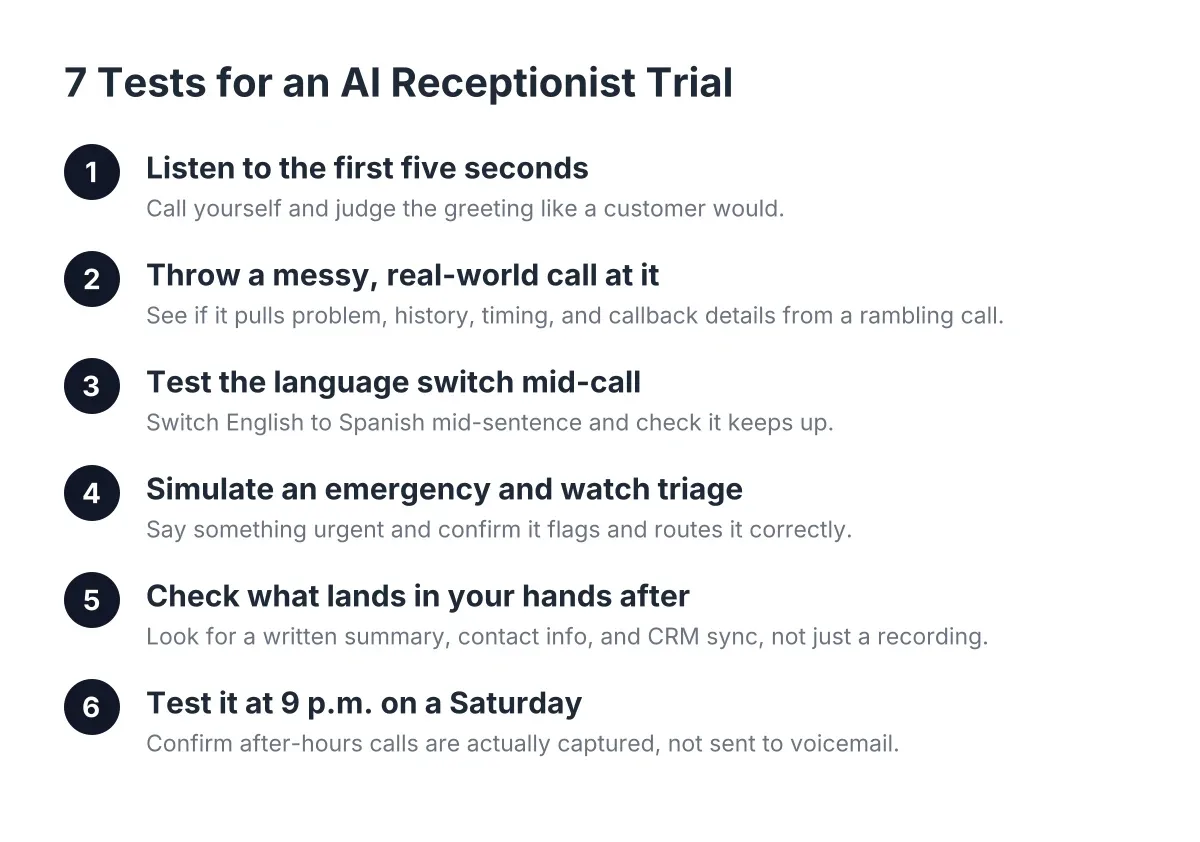
If you are the kind of owner who wants proof before trust, the fix is simple: call the line yourself. Ask it about a job you actually do, switch to Spanish mid-call, try to stump it. Then check what the summary says about your own call come Monday. That is the whole review process, tested with the one caller whose judgment you trust most.
If you're losing revenue to missed calls, NeverMiss ATX can help.
Prefer to talk it through? Call (512) 980-9267 — a quick call is usually the fastest way to get a straight answer for your situation.