AI Receptionist for a Solo Plumber vs. a Multi-Location Crew: 8 Real Differences
An AI receptionist for a solo plumber does a different job than one answering for a 15-tech, three-location crew. When you are evaluating an AI receptionist multi-location crew setup against a solo configuration, the same technology powers both, but the stakes and operating logic are entirely different. The solo plumber needs every call caught while he is under a sink in Pflugerville. The multi-location operator needs 40 simultaneous callers routed, scored, and booked without a single one hearing a busy signal. If you are deciding whether a solo plumber setup or a full crew configuration fits your business, this article walks through exactly what changes between the two, from what the caller hears on the first ring to what lands in your CRM.
We built our AI receptionist in Austin for Central Texas trades, so the examples below reflect the calls that actually come in here: burst pipes in February freezes, slab leaks in August, and hail-driven roof calls 48 hours after a storm rolls through Georgetown. Here are eight differences that matter, and one section on what stays the same at any size.
1. What the Caller Hears When the AI Answers
Callers hear a natural voice that answers on the first or second ring, greets them by your business name, and asks what they need. There is no robotic menu, no "press 1 for service." The AI asks the same questions a good office manager would: what is the problem, where are you located, and how urgent is it.
For a solo plumber, the greeting is personal. "Thanks for calling Martinez Plumbing, how can I help?" The caller often assumes they reached a small office, which is the point. For a multi-location crew, the AI adds a routing question early: it confirms whether the caller is in Round Rock, Cedar Park, or South Austin, so the lead lands with the right branch before a human ever touches it.
This matters because skepticism about voice quality is the number one reason owners hesitate. The honest answer is to test it yourself. Call the line, describe a fake water heater failure, and try to stump it. A good AI receptionist handles interruptions, mid-sentence corrections, and a caller who changes their mind about the appointment time.
2. Call Volume: One Missed Call vs. a Hundred at Once
A solo plumber misses calls one at a time; a storm-driven crew misses them a hundred at a time. The technology requirement is different, and so is the math. For the solo operator, the problem is availability: you are on site, elbow-deep in a job, and the phone rings. For the multi-location crew, the problem is concurrency: after a hailstorm hits Leander, the phone rings 60 times in two hours.
However, the cost of a missed call is brutal at both sizes. Research from MIT Sloan and InsideSales.com found the odds of contacting a lead drop 100-fold when the callback happens at 30 minutes instead of within 5 minutes, and the odds of qualifying that lead drop 21-fold. A solo plumber calling back at lunch has already lost most of those jobs to whoever answered first.
For crews, verify the system handles unlimited simultaneous calls before you sign anything. A national answering service with 12 human agents queues callers during a storm surge. An AI receptionist answers all 60 at once, which is the entire reason storm and restoration businesses in Central Texas adopt it first.
3. How an AI Receptionist Qualifies Leads for a Solo Plumber
For a solo plumber, the AI receptionist qualifies leads by asking three to five questions and filtering the calls you should never drive to. It captures the caller's name, address, problem description, and urgency, then sends you a summary so you can decide from the truck whether this is a $150 faucet swap or a $3,500 repipe.
The solo configuration is deliberately simple. You are the only decision-maker, so every qualified lead goes straight to your phone as a text summary, and hot leads can trigger a live transfer if you opt in. Say you are finishing a drain job in Buda when a caller reports water pouring through a ceiling in Hyde Park. The AI flags it urgent, captures the address, and you get the full picture in one glance instead of a voicemail you will hear at 6 p.m.
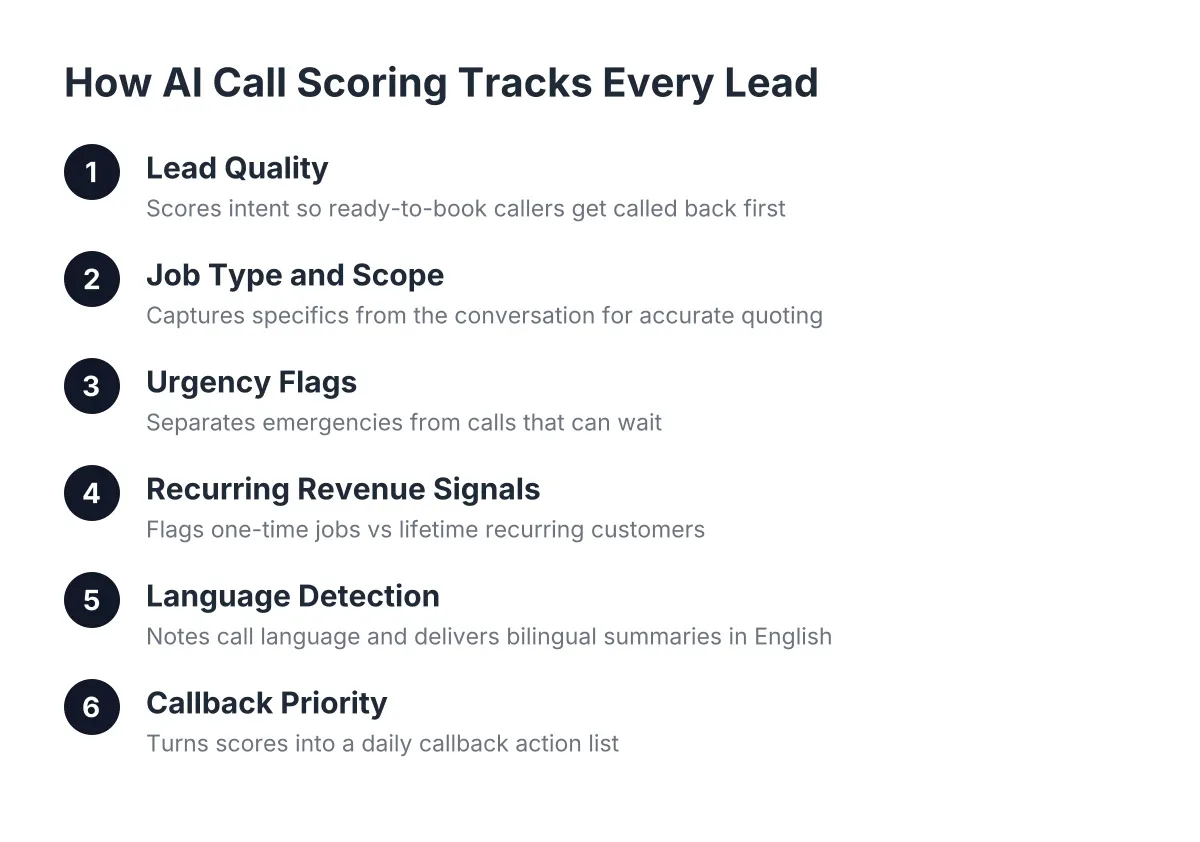
Multi-location crews layer scoring on top. AI call intelligence scores each lead, so an office lead in your dashboard sees the $7,500 insurance roof claim ranked above the gutter cleaning inquiry. Same qualification engine, different downstream logic.
4. Booking and Routing: Direct to Your Calendar vs. Territory-Based Assignment
A solo plumber wants the AI to send a booking link tied to one calendar: yours. The caller describes the job, the AI qualifies it, and the caller gets a link to pick a slot you actually have open. No back-and-forth, no double-booked Tuesday. Jobs get booked while you are still on site at the previous one.
In contrast, an AI receptionist multi-location crew needs territory logic built in. The AI confirms the service address, matches it to the right branch or crew lead, and books against that team's availability. A restoration company covering Austin, Georgetown, and Fort Worth cannot have a Fort Worth water damage call booked onto an Austin tech's calendar. The routing rules get set up once, during onboarding, and the AI applies them on every call after that.
Either way, the outcome the caller experiences is identical: they called, a helpful voice answered, and they left with a confirmed appointment. That speed is what wins jobs against the competitor whose phone went to voicemail.
5. Bilingual Answering Matters More Than You Think in Central Texas
Bilingual answering is standard on every call, not an upsell, and in the Austin market that is not optional. A meaningful share of home service calls in Central Texas come in Spanish, and a caller who hears their language answered fluently books at a far higher rate than one asked to "hold for a Spanish speaker."
For the solo plumber who speaks only English, this is capacity you could not offer before. The AI conducts the entire call in Spanish, captures the lead, and sends you the summary in English. For multi-location crews, it means Spanish-language leads get qualified and routed with the same scoring as English calls, so nothing slips because of language.
Do not take a vendor's word on this. Call the line, start in English, switch to Spanish mid-sentence, and see whether the AI follows you. Ours does, and any system you pay for should.
6. Emergency Triage: Live Transfer for One Phone vs. an On-Call Rotation
Emergency triage works by letting the AI detect urgency keywords, confirm severity with a follow-up question, and then either transfer the call live or escalate the summary immediately. For a solo plumber, live transfer is opt-in and points at one number: yours. A burst pipe at 11 p.m. rings through if you have after-hours transfer on; otherwise you get an urgent-flagged summary the moment you wake up.
For a multi-location crew, the transfer target changes with your on-call rotation. Monday night it rings the North Austin lead; the following week it rings someone else. The AI follows the schedule you set, so genuine emergencies reach a human fast while routine calls wait for morning dispatch.
One honest limitation: an AI receptionist triages and routes, but it does not diagnose. A caller describing a gas smell needs a human decision and possibly a 911 referral, and your escalation rules should treat those calls as immediate transfers, no exceptions.
7. What It Costs at Each Size, and How the ROI Math Differs
As of 2026, AI phone answering for a solo plumber typically runs in the low hundreds of dollars per month, while multi-location configurations with CRM sync, routing rules, and higher call volume run higher, though still a fraction of one office hire. Compare that to a full-time receptionist at $35,000 to $45,000 a year, who still cannot answer two calls at once or work weekends.
The ROI math is different at each size, so run your own numbers:
- Solo plumber: one recovered emergency call per month, say a $600 water heater job, covers the subscription several times over.
- Small crew (3 to 8 techs): the win is after-hours and overflow capture during summer rush, when everyone is on jobs and the office line rings unanswered.
- Storm-driven crew (10 to 20 techs): the win is surge capture. If a hail event generates 200 calls in 72 hours and your team could historically answer 90 of them, the AI answering the other 110 at a $7,500 average roofing ticket changes the year.
Worth noting for owners worried this is a staffing decision in disguise: according to NFIB, 98% of small employers using AI tools reported no change in employee headcount. The AI answers the phone so your people can stay on the job; it does not push anyone out.
8. Setup Complexity: An Afternoon vs. a Structured Onboarding Week
A solo plumber setup takes about an afternoon: forward your existing number, answer questions about your services and service area, connect your calendar, and make a few test calls. There is no new phone number to advertise and no hardware. You keep the number on your truck wraps and yard signs.
By comparison, a multi-location setup takes a structured onboarding, typically a week, because there is more to define: branch territories, on-call rotations, insurance claim intake questions for restoration work, and webhook connections to HubSpot, Salesforce, Zoho, or Zapier so every lead lands in your existing pipeline automatically.
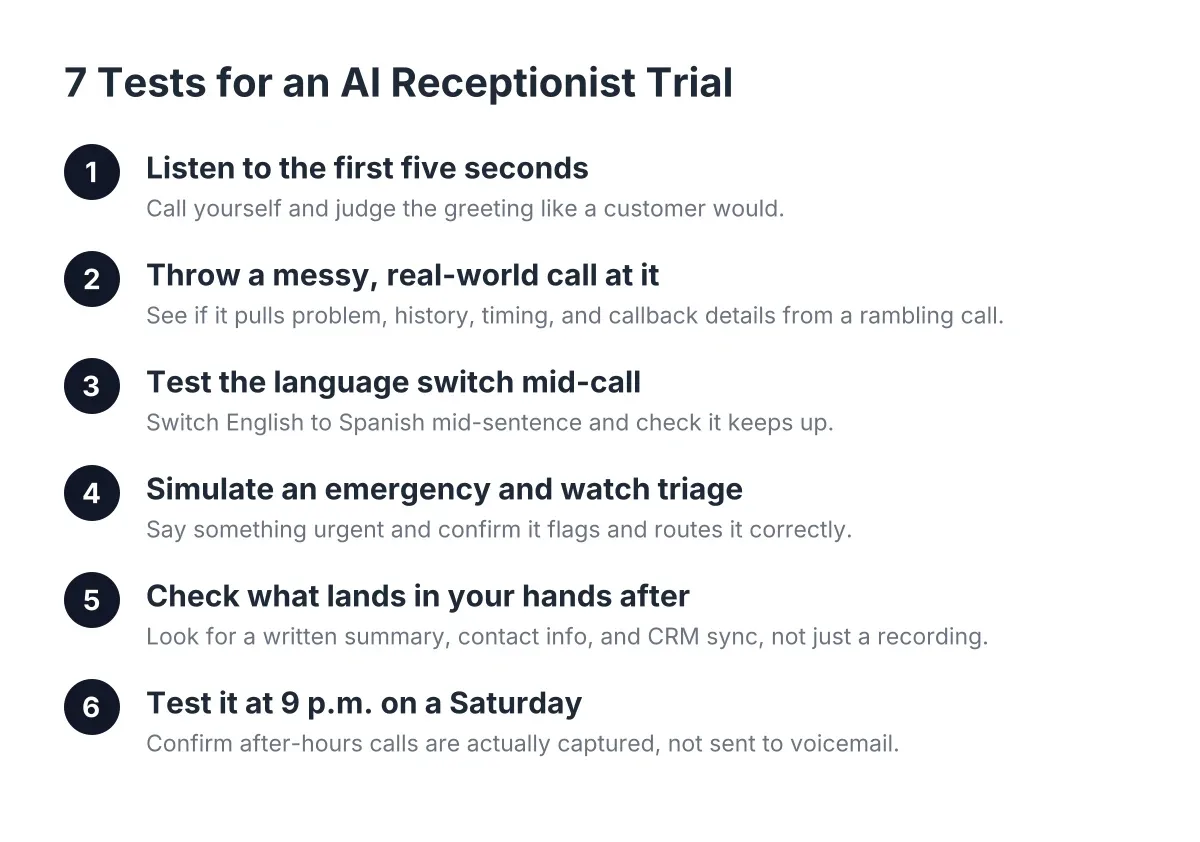
Either way, insist on testing before going live. Run your hardest calls at it: the rambling caller, the Spanish speaker, the price shopper, the 2 a.m. emergency. If the vendor will not let you stress-test the system, that tells you something.
What Stays the Same for a Solo Plumber or a 20-Tech Operation
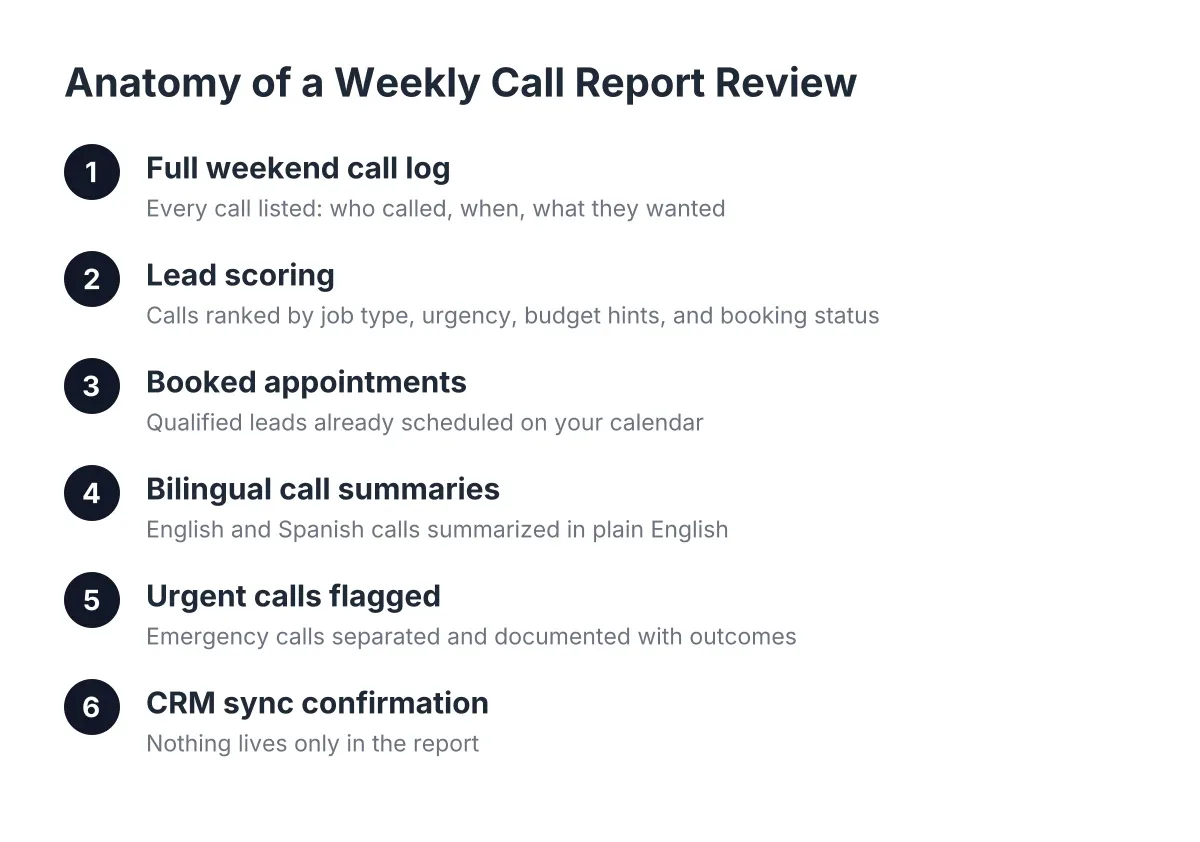
Whether you run solo or manage three branches, the fundamentals of an AI receptionist do not change: it answers 24/7, captures every lead, qualifies before you follow up, and sends you a record of every conversation. A solo plumber gets the same call summaries and Monday morning report a 20-tech operation gets; the crew just has more rows in it.
The trust question is also identical at every size. A Five9 survey found 75% of consumers prefer talking to a human for support, and 84% know companies use AI for customer service. Both facts point the same direction: callers accept AI when it is fast, competent, and honest, and they resent it when it stalls them. The bar is not "sounds human." The bar is "solved my problem faster than the voicemail I would have gotten otherwise."
So match the configuration to your operation, not the other way around. A solo plumber equipped with an AI receptionist should stay simple: one calendar, one transfer number, summaries to one phone. A multi-location build should carry routing, scoring, and CRM sync from day one. Then call the system yourself, in both languages, and try to stump it before a paying customer in Austin, TX ever does.
If you're losing revenue to missed calls, NeverMiss ATX can help.
Prefer to talk it through? Call (512) 980-9267 — a quick call is usually the fastest way to get a straight answer for your situation.