Virtual Receptionist Service vs. Live Call Center: 8 Comparisons for Austin Trades
If you run a lawn care route in Pflugerville or a roofing crew that lives and dies by the next hailstorm, you already know the math: the phone rings while you're on a ladder, and the caller books with whoever answers first. This comparison puts every option side by side, a full-time hire, a national call center, a virtual receptionist service, and an AI receptionist, priced against the real call volumes and job values of Central Texas trades. No sales call required. Just the numbers and trade-offs so you can decide what actually fits your business.
Quick definitions before the list. A live receptionist is an employee at a desk. A national answering service is a call center where shared agents read from a script for hundreds of businesses. Additionally, a traditional virtual receptionist service is remote humans answering under your business name, billed by the minute. An AI receptionist is software that answers, qualifies, and books on its own, at any hour, on any number of simultaneous calls.
Here are the eight comparisons that matter, in the order most owners ask about them.
1. Monthly Cost: What Each Option Runs in 2026
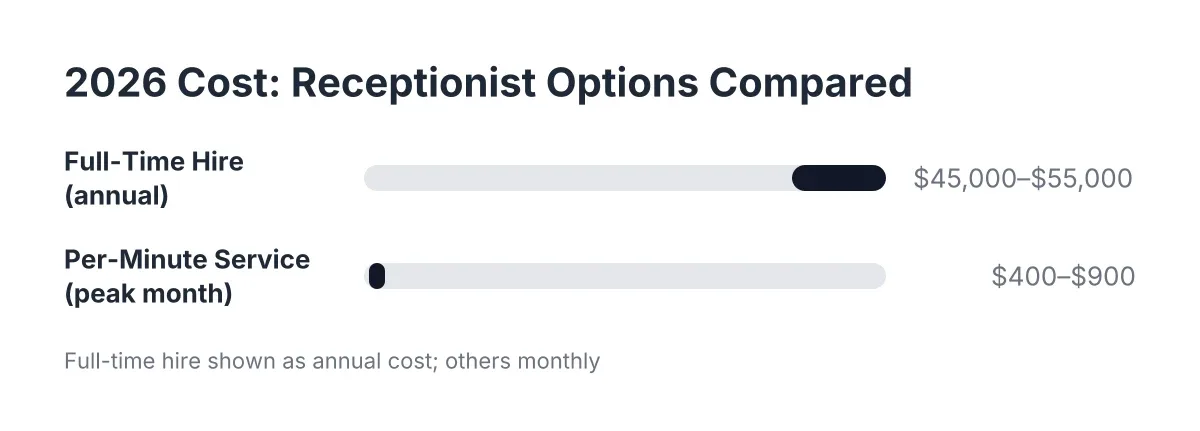
The spread here is wide. According to the U.S. Bureau of Labor Statistics, the median receptionist wage was $17.90 per hour in May 2024, about $37,230 per year before payroll taxes, benefits, or overtime. Add those in and a full-time hire realistically costs $45,000 to $55,000 a year, and that person still goes home at 5 p.m.
National answering services and per-minute virtual receptionist services usually look cheap at the entry tier, then climb fast. A 100-minute plan at $1.50 to $2.50 per minute sounds fine until spring booking season triples your call volume and the overage bill lands. As of 2026, a busy pest control or lawn care operation can burn through $400 to $900 a month during peak months on per-minute plans. AI receptionist plans typically run as flat monthly pricing, so the cost stays the same whether March brings 80 calls or 400.
2. Speed to Answer: Rings, Holds, and the 5-Minute Window
Speed to answer is where the money is won or lost. A foundational MIT Sloan / InsideSales.com study found the odds of contacting a lead drop 100-fold, and the odds of qualifying that lead drop 21-fold, when the callback happens at 30 minutes instead of within 5 minutes.
Compare the options against that window:
- Full-time hire: answers fast during business hours, sends after-hours calls to voicemail
- National call center: answers in 30 to 90 seconds, but callers often sit on hold during storm surges when every roofer's line lights up at once
- Traditional virtual receptionist service: similar hold-time risk, since human agents can only take one call at a time
- AI receptionist: answers on the first or second ring, every time, including 2 a.m., because software does not queue
For storm-driven businesses, that last point is the whole game. When hail hits Round Rock, 200 homeowners call roofers in the same 48 hours. Whoever answers first usually gets the inspection.
3. Simultaneous Call Handling During a Storm Surge
Here is a scenario every Central Texas roofer recognizes. A supercell drops golf-ball hail on Cedar Park at 6 p.m. on a Friday. By Saturday morning your line is getting 15 calls an hour. A single receptionist handles one at a time. A national call center queues the rest behind callers for a plumbing company in Ohio. Fourteen of those callers hang up and dial the next roofer on Google.
An AI receptionist takes all 15 at once, captures the address and insurance carrier, and delivers a booking link to each caller. At a $7,500 average roofing job, missing even four of those calls in one weekend costs $30,000 in potential revenue. That is the entire year's cost of the service, lost in 48 hours. If your business spikes with weather, unlimited simultaneous answering is not a nice-to-have; it is the first fit criterion to check.
4. After-Hours Coverage: Where Recurring Revenue Slips Away
After-hours answering separates the options fastest. A full-time hire covers 40 of the week's 168 hours. National services charge premium rates for nights and weekends. An AI receptionist covers all 168 hours at the same flat rate, which matters because pest control work skews toward new-customer calls landing after 5 p.m., when a homeowner spots roaches during dinner.
For recurring service businesses, the stakes compound. A missed one-time caller costs you one job. A missed first call from a would-be weekly mowing customer costs the whole contract, easily five times the value of a single visit. The new recurring customer is won or lost on that first call, and most first calls do not get a second attempt. They just move down the search results.
5. Call Quality: Can Callers Tell, and Do They Care?
Skepticism about AI call quality is fair, so here is the honest picture. According to a Five9 survey, 75% of consumers prefer talking to a human for customer support, and 84% already know companies use AI for customer service. Callers are not fooled, and they do not need to be.
However, the real comparison is not AI versus a great human. It is AI versus voicemail, hold music, or an out-of-state agent mispronouncing Manchaca. A well-built AI receptionist answers instantly, knows your service area from Georgetown to Leander, asks qualifying questions in plain language, and books the appointment. A homeowner with a burst pipe cares about speed and competence, not the species of the voice. The practical test: call one yourself and try to stump it before you sign anything. Any provider confident in their product will invite that.
6. Bilingual Answering: Standard or Surcharge?
In Central Texas, English-only answering leaves revenue on the table, full stop. A meaningful share of homeowners and property managers in Austin's service corridors prefer to book in Spanish, and a caller who hits a language wall hangs up and calls a competitor who answers en español.
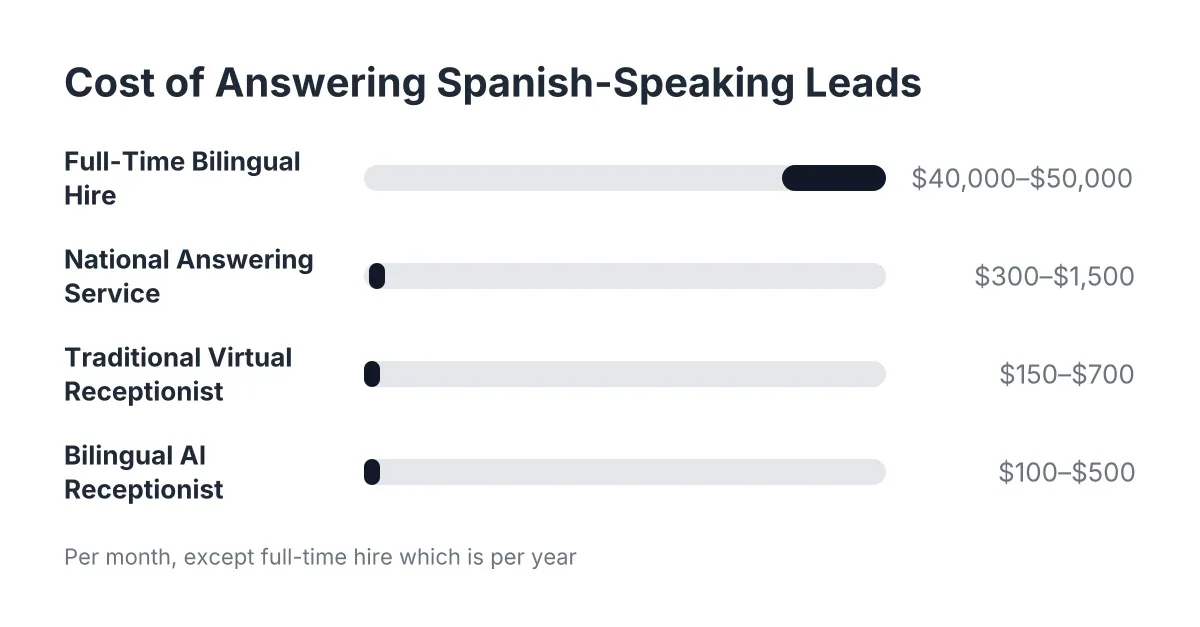
Check how each option handles this. Bilingual hires command higher wages, deservedly. National call centers often bill Spanish answering as a premium add-on or route those calls to a separate, slower queue. Some AI receptionists include Spanish on every plan by default, handling the entire call, lead capture, and booking in either language. Do not take "bilingual support" on a pricing page at face value; call the demo line in Spanish and listen to what actually happens.
7. Booking and CRM Sync: Turning Answered Calls Into Booked Jobs
An answered call that ends with "someone will call you back" is only half a win. The remaining half is getting the lead booked and into your system before your crew finishes the current job. This is where the options split sharply.
Compare what happens after hello:
- Full-time hire: books directly into your calendar, but only during office hours
- National call center: takes a message; you get an email or text to chase later
- Traditional virtual receptionist service: some plans book appointments, usually at a higher per-minute tier
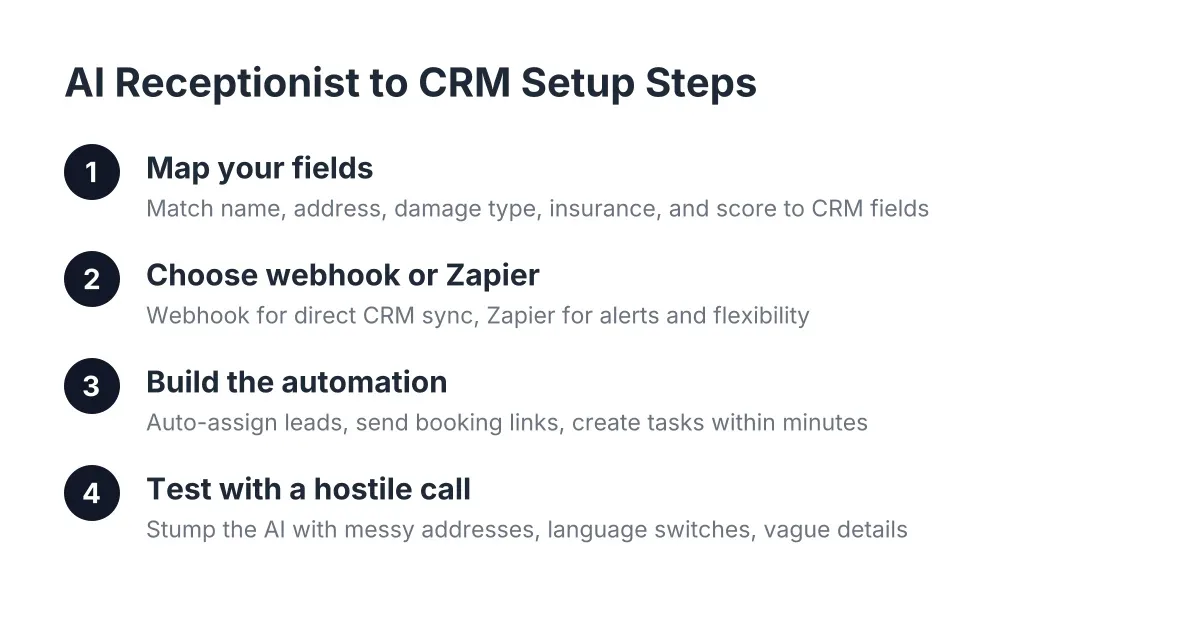
- AI receptionist: qualifies the lead, sends a booking link during the call, scores and summarizes it, and pushes it to HubSpot, Salesforce, Zoho, or anywhere Zapier reaches
For an owner running a 6-person crew, that last workflow means you open your phone between jobs and see three booked estimates, not three voicemails to return. Given the MIT Sloan callback data above, "message taken" and "appointment booked" are not the same product.
8. Setup, Scaling, and the Emergency Question
Setup complexity scares off more small owners than price does, and with reason. Only 24% of small employers currently use AI tools at all, according to an NFIB survey, so if this feels unfamiliar, you are in the majority. The good news: forwarding your existing number to an AI receptionist is a same-day task, not an IT project. Hiring takes weeks; onboarding a national service takes script revisions and training calls.
One honest limitation: no automated system should be the last word on a true emergency, like a gas smell or active flooding. The right setup triages urgent calls and live-transfers them to you or your on-call lead, and a licensed pro should always make the final safety call on site. Scaling cuts the other way in AI's favor. When spring booking season doubles your call volume, a flat-rate AI plan absorbs it; a per-minute plan bills you for it, and a single hire simply cannot answer two phones.
Which Option Fits Your Business? A Quick Decision Guide
Match the option to your call pattern, not to a feature list. The best answering service for a small business is the one built for how your phone actually rings.
- Steady 9-to-5 volume, complex office admin needs: a full-time hire earns their keep beyond the phone
- Low volume, simple messages, no booking needed: a budget call answering service for small business use may suffice
- High after-hours volume, recurring contracts on the line: an AI answering service for small business owners covers the 128 hours a week a hire cannot
- Storm-driven spikes with 100+ simultaneous calls: AI is the only option that does not queue, and local market knowledge separates the useful ones from the generic ones
For most Austin trades, the honest answer is a hybrid: you and your crew handle the relationships and the work, and an AI receptionist captures every call you physically cannot take because you are on site, in an attic, or 40 feet up on a Georgetown roof in 95° heat.
The Bottom Line for Central Texas Trades
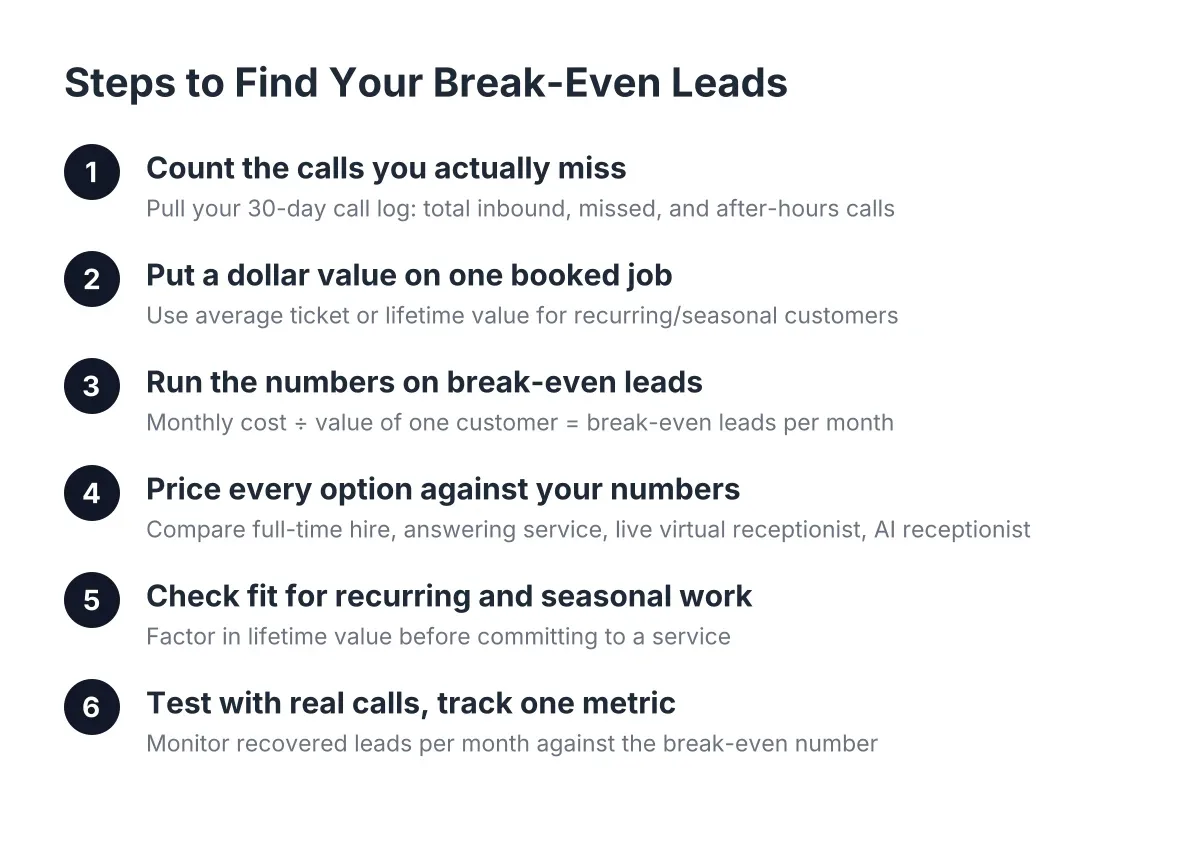
Run your own numbers before deciding. Take last month's missed calls, multiply by your average job value, then multiply recurring wins by lifetime value. For a lawn care company where a weekly customer is worth $2,000 a year, even five missed first calls a month is $10,000 in annual contracts walking to a competitor. Against that figure, the differences between a $45,000 hire, a $500-a-month per-minute plan, and a flat-rate virtual receptionist service stop being abstract. Then test the finalists the same way you would test a new hire: call them, in English and in Spanish, at 9 p.m. on a Saturday, and see who picks up.
If you're losing revenue to missed calls, NeverMiss ATX can help.
Prefer to talk it through? Call (512) 980-9267 — a quick call is usually the fastest way to get a straight answer for your situation.