Website Chatbot Plus AI Phone Answering: 8 Ways Dual Lead Capture Books More Jobs
You already said yes to an AI receptionist. Now the question is how to set it up so nothing slips past you. The answer most Austin trades land on is a dual lead capture chatbot plus AI phone receptionist running together, one net for the people who call, another for the people who browse your site at 9:40 pm with a dead AC and no interest in dialing. This article walks through exactly how the dual setup works, from first ring (or first click) to booking confirmation, written by the people who built it for Central Texas trades, not a generic SaaS explainer.
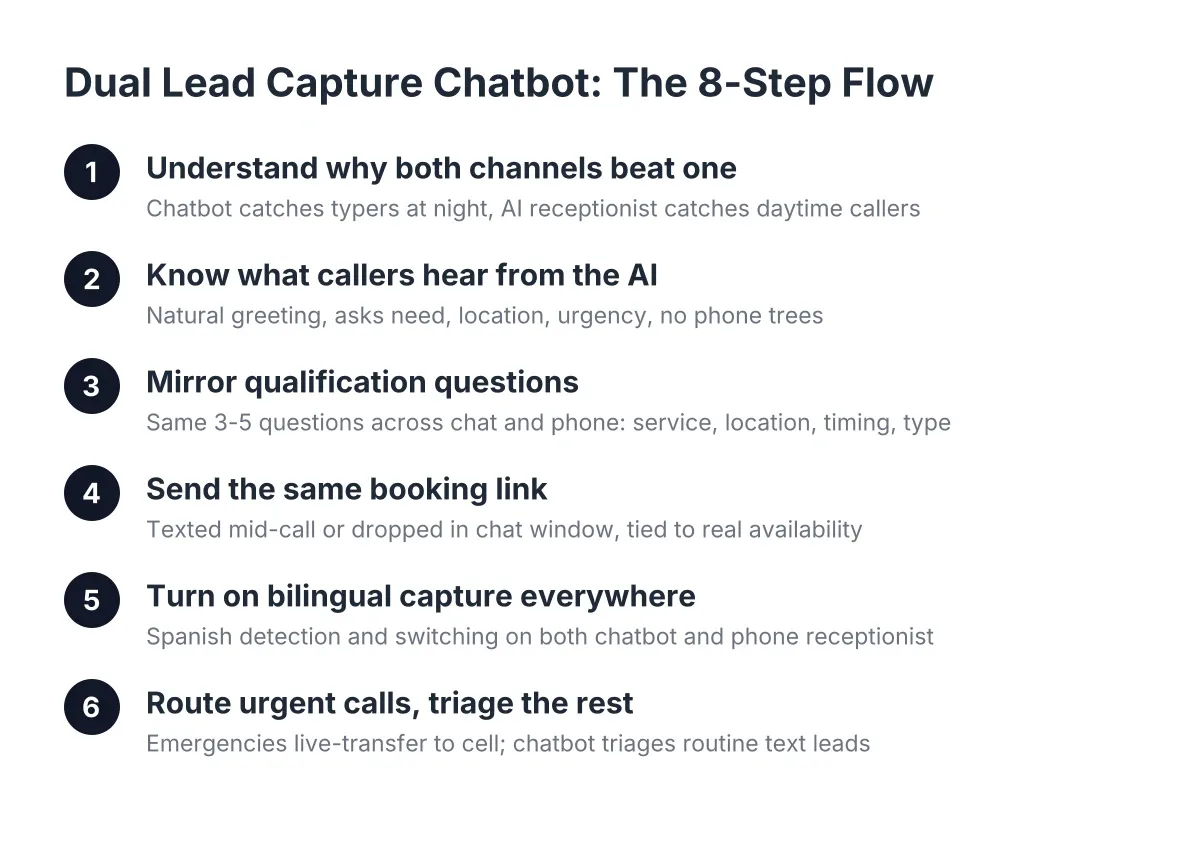
Here is the short version: some leads call, some leads type. If you only capture one group, you are leaving the other to your competitors. Below are eight specific ways to run both channels together so every lead lands in the same place, gets the same qualification questions, and books from the same link, whether you are on a ladder in Pflugerville or asleep before a 6 am start.
1. Understand Why a Website Chatbot Plus AI Receptionist Beats Either One Alone
A website chatbot plus an AI phone receptionist covers both ways customers actually reach out: the 2 pm caller who wants to talk, and the 10 pm browser who will never pick up the phone. Running both means one lead capture system instead of two blind spots.
Think about your own week. A homeowner in Round Rock searching "lawn care near me" during lunch will probably call. The same homeowner comparing quotes after the kids are in bed will type a question into your website instead. Phone-only setups miss the typers. Chat-only setups miss the callers. Together, they capture both, and both feed the same dashboard, so you review one list of leads on Monday morning instead of chasing scraps across voicemail and a contact form inbox.
2. Know Exactly What Callers Hear When the AI Answers
When the AI receptionist picks up, the caller hears a natural, conversational greeting with your business name, then gets asked what they need, where they are, and how urgent it is. The whole exchange sounds like a sharp front-desk person, not a phone tree, and there are no "press 1" menus.
This matters because skepticism about call quality is the number one reason owners hesitate. Fair enough. The honest answer is that modern AI phone answering handles the conversations trades actually get, service requests, pricing questions, booking requests, and it does so in plain conversational English or Spanish. If a caller asks something genuinely outside its lane, like a detailed diagnosis of a failing compressor, it captures the details and flags the call for you rather than guessing. The best way to settle the quality question is to call the line yourself and try to stump it before a paying customer ever hears it.
How a Dual Lead Capture Chatbot and AI Phone Receptionist Coordinate
Both channels run on the same qualification logic. Same questions, same lead scoring, same booking link delivery. A lead that starts in chat and later calls gets recognized as one lead, not two, so your pipeline stays clean.
3. Mirror Your Qualification Questions Across Both Channels
Set up the chatbot and the phone receptionist to ask the same three to five qualifying questions: service needed, location, timing, property type, and whether it is a one-time job or recurring service. Matching questions means every lead arrives with the same information, no matter which door they came through.
For recurring and seasonal businesses, that last question is the one that pays. A one-time mow is worth maybe $60. A weekly customer through an Austin growing season is worth $1,500 or more, and a recurring customer who stays three years is a different business entirely. Configure both channels to capture recurring intent explicitly, so your Monday report separates the lifetime-value leads from the one-offs.
4. Send the Same Booking Link From Both Channels
Both the chatbot and the AI receptionist should deliver one booking link tied to your real availability. A caller gets it texted to their phone mid-conversation; a website visitor gets it dropped straight into the chat window. Either way, the lead books while they are still interested instead of waiting for a callback. When using a dual lead capture chatbot system, speed becomes even more critical to conversion.
Speed is the whole game here. According to a foundational study from MIT Sloan School of Management and InsideSales.com, the odds of contacting a lead drop 100-fold when follow-up happens at 30 minutes instead of within 5 minutes, and the odds of qualifying that lead drop 21-fold. You cannot call back in 5 minutes from under a crawl space. The booking link closes the loop without you touching your phone, and the job is booked before you climb out.
5. Turn On Bilingual Capture Everywhere, Not Just the Phone
Enable Spanish on both channels from day one; every plan includes it. The AI receptionist detects the caller's language and switches mid-call if needed. The chatbot does the same in text. No separate line, no "para español" menu, no awkward handoff.
Central Texas is a bilingual market, and a Spanish-speaking homeowner in Georgetown who hits an English-only chatbot bounces in seconds. Here is a hypothetical worth sitting with: suppose a pest control owner in Leander gets 40 inbound contacts a week during summer swarm season, and 8 of them open in Spanish. English-only capture quietly drops those 8 every week. Bilingual capture on both channels books them, and seasonal pest work converts to quarterly recurring plans more often than any other first contact.
6. Route Urgent Calls to Live Transfer, Let the Chatbot Triage Text
Configure the opt-in live transfer rules so genuine emergencies, a burst pipe, a gas smell, a total AC failure in 95° heat, ring through to your cell immediately. Everything else gets captured, qualified, and booked without interrupting you on site. The chatbot follows parallel logic: urgent chats get flagged and pushed to you with full context.
Be honest with yourself about the triage settings. Set the bar too low and you are getting interrupted mid-install for a mulch quote. Set it too high and a real emergency sits in a queue. Start with a tight definition of urgent, then adjust after your first two weeks of call summaries. One trade-off to acknowledge plainly: AI handles triage and capture, but a true emergency still needs you or a qualified pro on the other end. The system's job is getting that call to you fast, not solving the burst pipe itself.
7. Wire Both Channels Into One CRM Feed
Connect lead webhooks so every captured lead, phone or chat, lands in the same place: Zapier, HubSpot, Salesforce, Zoho, or a plain spreadsheet if that is your system. One feed means one follow-up list, and the one-click call bridging from the dashboard means you can return a call between jobs without hunting for the number.
A practical setup order for a solo operator:
- Connect the webhook or CRM sync first, before you announce the new number or chat widget anywhere.
- Test one fake phone lead and one fake chat lead, and confirm both appear in the same pipeline with the channel labeled.
- Set the AI call intelligence scoring thresholds so hot leads get flagged for same-day callback.
- Check the Weekly Monday Morning Report against your CRM after week one to catch anything leaking.
In addition, worth knowing: an NFIB survey found only 24% of small employers use AI tools for business activity. That gap is an opening. Most of your competitors in Cedar Park are still letting after-hours calls hit voicemail, and voicemail does not text a booking link.
8. Match the Dual Setup to Your Seasonal Peaks
Adjust your qualification scripts and chatbot prompts before each season turns, not after. Spring means lawn and landscaping booking surges; June through September means HVAC call velocity triples on the first 100° week; fall and after-hours mean pest activity. The AI receptionist handles overflow the same at call 3 and call 30, which is where a solo operation feels the dual setup most.
For example, say a hypothetical solo HVAC tech in Austin misses a third of his inbound calls during a July heat wave because he is physically inside attics all day. If he averages 15 calls a day in peak season, that is roughly 5 missed calls daily. Even at a conservative one booked job per three missed calls and $300 average ticket, that is about $500 a day walking to the next listing on Google. The dual capture setup answers all 15, books the straightforward ones, flags the emergencies for live transfer, and texts the rest a booking link. No new hire, no national call center reading a script with your business name misspelled. The NFIB's Small Business and Technology Survey found 98% of small employers using AI reported no change in employee headcount; this is about capturing what already rings, not restructuring your business.
One honest limitation of running both channels
Two channels means two things to configure and keep updated. If your services, pricing ranges, or service area change, update the chatbot and the phone scripts together, or the channels will give customers different answers. Put it on your seasonal checklist and the problem never surfaces.
What the Full Flow Looks Like: From First Ring to Booked Job Using Dual Lead Capture Chatbot Technology
Pull the eight pieces together and here is the complete path. A lead calls at 7:45 pm while you are at dinner. The AI receptionist answers in two rings, greets them by your business name, asks what they need and where they are, switches to Spanish if the caller does, and scores the lead. Routine request: they get a booking link by text and pick a slot before dessert. Emergency: your phone rings with context already attached.
Meanwhile, a second lead on your website at 11 pm types "do you service Hutto?" into the chat. Same questions, same scoring, same booking link, same pipeline. Monday morning, both leads sit in one report with summaries, scores, and channel labels, and you review the whole weekend in ten minutes over coffee.
That is the dual lead capture chatbot strategy in full: a website chatbot plus AI receptionist on the phones, one brain behind both, zero leads deciding between you and the next Google result because nobody answered. Worth noting as you roll it out: a Five9 survey found 84% of consumers already know companies use AI for customer service, and the same Five9 research found 75% still prefer talking to a human for support. Both facts can be true. The dual setup respects that; it answers instantly when you cannot, captures every lead in both languages, and gets the human, you, on the line for the calls that genuinely need you. Test it yourself before a customer does. Call the line, open the chat, and try to stump both.
If you're losing revenue to missed calls, NeverMiss ATX can help.
Prefer to talk it through? Call (512) 980-9267 — a quick call is usually the fastest way to get a straight answer for your situation.