Can AI Receptionists Handle Emergency Calls? 7 Truths for Austin Trades
A burst pipe at 11pm does not wait for business hours, and neither does the caller. If you run an emergency trade in Central Texas, the real question is not whether you need help answering the phone; it is whether AI receptionists can handle emergency calls from a panicked caller with water pouring through a ceiling. The honest answer: yes, with specific conditions, and the conditions matter more than the marketing. Below are seven unfiltered truths comparing every option, a live hire, a national call center, and an AI receptionist, priced against the call volumes and job values Austin trades actually see.
First, the stakes. An MIT Sloan / InsideSales.com study found the odds of contacting a lead drop 100-fold, and the odds of qualifying that lead drop 21-fold, when the callback happens at 30 minutes instead of within 5 minutes. For a routine lead, that is painful. For an emergency caller, there is no callback window at all. They hang up and dial the next number on Google.
1. Emergency callers abandon faster than any other lead, so answering first wins the job
A homeowner with a flooding kitchen gives you one ring, maybe two, before moving to the next listing. Routine callers leave voicemails; panic callers never do. In that moment, the business that answers first wins a job that often starts at $500 for the stop-the-bleeding visit and runs to $7,500 or more once water damage and restoration follow-on work gets booked.
This is why the answering question is really a speed question. Whatever option you pick, measure it on one number: what percentage of after-hours emergency calls get answered on the first ring, every night, every weekend, every holiday.
2. Can AI receptionists handle emergency calls from a panicked caller at 2am? Here is what actually happens
A well-configured AI receptionist can handle a panicked 2am caller by answering on the first ring, recognizing emergency keywords like flooding, no-cool, or sparking panel, capturing the address and callback number, and either booking the job or live-transferring the call to your on-call phone. The call never hits voicemail, and nothing depends on a human waking up first.
The mechanics matter. Modern AI receptionists are not phone trees. The caller says "my water heater burst and it's flooding the garage," and the AI responds conversationally: confirms the address, asks whether the water shutoff is accessible, and flags the call as urgent. If you have opted into live transfer, it bridges the caller straight to whoever is on call.
However, be honest about the limits. An AI receptionist triages and routes; it does not diagnose. It will not tell a caller whether their breaker panel is safe to touch, and it should not. Its job is to calm the caller, capture the details, and get the right human moving. Any provider claiming the AI itself resolves emergencies is overselling.
3. The live hire comparison: $38,000 a year covers 40 hours, and emergencies ignore schedules
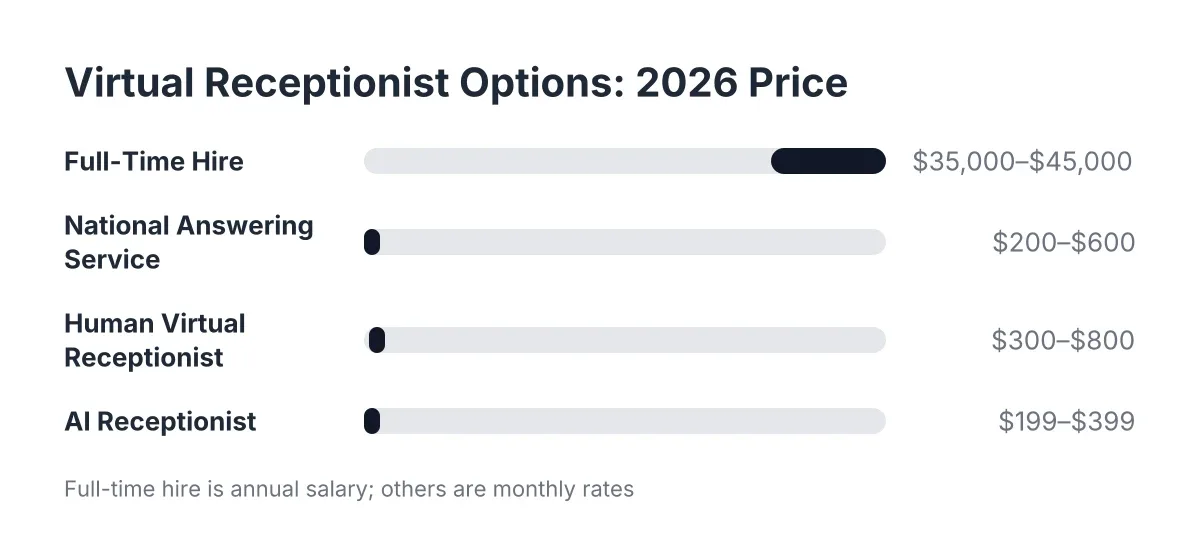
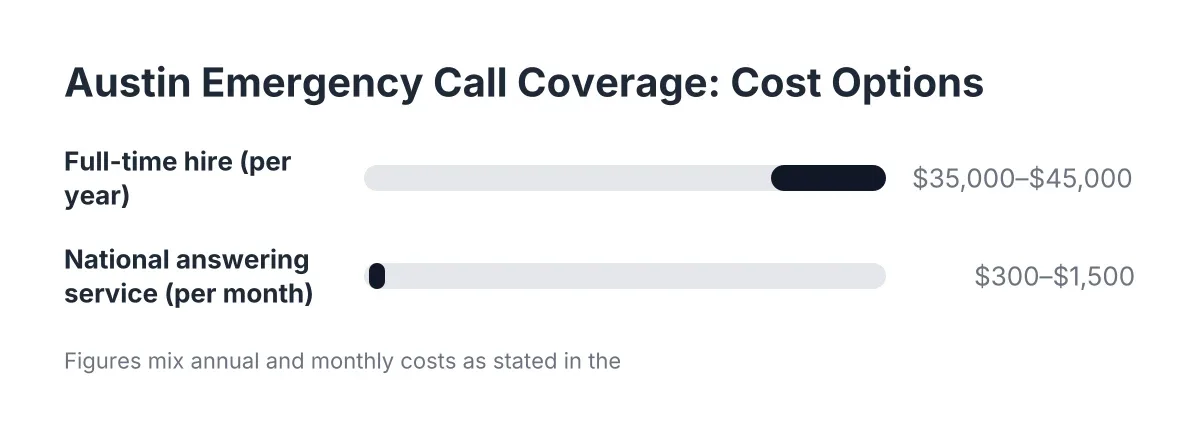
A full-time receptionist in Austin runs roughly $35,000 to $45,000 a year with payroll taxes, and that estimate buys you Monday through Friday, 8 to 5. Emergencies cluster in the other 128 hours of the week: the Friday night freeze, the Sunday hail storm, the 11pm roach call. Covering nights and weekends with humans means two to three more hires or a rotating on-call burden your office lead will eventually quit over.
In addition, one person answers one call at a time. When a hailstorm rolls through Round Rock, call two goes to voicemail no matter how good your receptionist is. Worth noting: adding an AI receptionist rarely means cutting staff. According to NFIB, 98% of small employers using AI report no change in employee headcount. It fills the hours and overflow a human cannot.
4. The national call center comparison: they answer, but they do not know Pflugerville from Pearland
National answering services solve the 24/7 problem and staff real humans, which counts for something; a Five9 survey found 75% of consumers prefer talking to a human for support. But the trade-offs for an emergency trade are specific. Most charge per minute, often $1 to $1.50, so a storm week with 200 calls produces a bill you cannot predict. Their agents read a generic script, cannot distinguish a no-cool emergency during a 95-degree August from a thermostat question, and put your caller on hold when the whole Gulf Coast floods at once.
For storm and event-driven businesses, that last point is disqualifying. The 48 to 72 hours after a hail event is when your entire quarter gets booked. A call center that queues your callers behind every other client's callers is a bottleneck dressed up as coverage. An AI receptionist answers unlimited simultaneous calls; 100 callers at 6pm after a storm all get answered at once.
5. The cost math, priced against real Austin job values
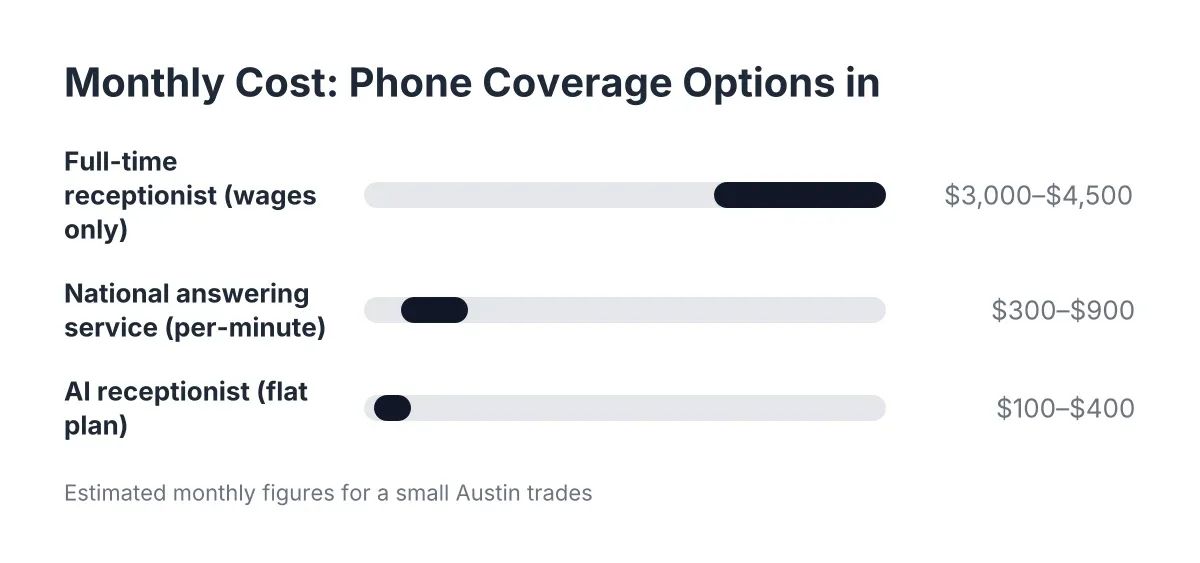
Run the comparison against your own numbers, not a vendor's brochure. Here is the 2026 landscape in rough, illustrative figures:
- Full-time hire: $35,000 to $45,000 a year, 40 hours of coverage, one call at a time.
- After-hours on-call rotation (you or your techs): free on paper, paid for in burnout, missed calls mid-job, and techs who quit.
- National answering service: $300 to $1,500 or more per month depending on minutes, with spiky bills after weather events and generic scripting.
- AI receptionist: typically a flat monthly rate in the low hundreds, 24/7, unlimited simultaneous calls, bilingual, with lead capture and booking built in.
Now weigh that against job value. If your average restoration or roofing job runs $7,500, a single captured after-hours emergency call can pay for a year of AI coverage. Most virtual receptionist services ask you to model ROI in months; for storm-driven trades, the honest unit is days after the event.
6. Live transfer is the feature that decides whether AI receptionists handle emergency calls credibly
Live transfer is the dividing line. Triage without a path to a human is just a smarter voicemail. The workflow that works for emergency trades looks like this: the AI answers on the first ring, qualifies the call as urgent based on what the caller describes, captures the address and callback number first, then bridges the call to your on-call line. If no one picks up, the caller is already booked or flagged for immediate callback with full details in hand.
Capturing details before the transfer matters more than owners expect. Suppose a Georgetown homeowner calls at 1am about a slab leak, the AI gathers the address and shutoff status, then the transfer drops because your tech is in a dead zone on a ranch road. With the old voicemail setup, that lead is gone. With details captured first, you call back in two minutes with everything you need, inside the five-minute window where contact odds are still 100 times better.
One trade-off to accept: a transfer adds a few seconds of bridging, and an occasional caller will find talking to AI unfamiliar. The Five9 research cited above shows 84% of consumers already know companies use AI for customer service, so the novelty is fading, but a stressed caller wants speed and competence, not a perfect imitation of a human. Configure the AI to be direct and fast, not chatty.
7. Can AI receptionists handle the storm-week spike that buries everything else?
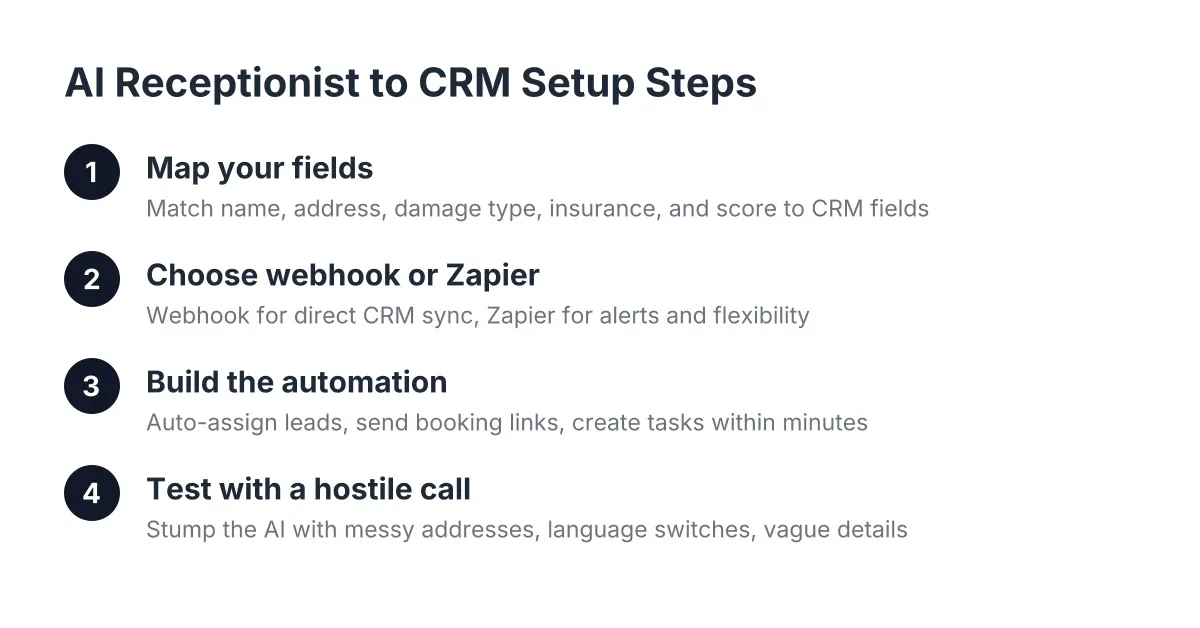
AI receptionists can handle storm-week call spikes because they answer every simultaneous call instantly, with no hold queue and no per-minute overage shock. After a hail event in Cedar Park or Leander, a roofing crew might field 150 calls in 48 hours. An AI receptionist answers all of them, captures insurance and claim details, scores each lead, and books inspections while your crews stay on roofs.
For example, picture a hypothetical Tuesday after golf-ball hail hits Georgetown. A typical three-truck roofing crew gets 60 calls before noon. A live hire answers maybe 25 and voicemails the rest. Additionally, a national call center answers most but queues callers behind other clients and captures a name and number, nothing more. An AI receptionist answers all 60, flags the 14 with active leaks for immediate live transfer or callback, books 30 inspections with the booking link, and sends you call summaries you can scan from the truck. Same storm, three different quarters.
Bilingual capability belongs in this math too. Central Texas emergency callers reach out in Spanish as often as English, and an AI receptionist that handles both on every call, without a separate line or a premium tier, captures leads a monolingual front desk never hears from.
What about setup? Emergencies will not wait for a six-week onboarding
Setup for an AI receptionist takes days, not weeks, for a typical Austin trade. You define your service area, your emergency triage rules (what triggers live transfer, who is on call, what gets booked versus flagged), and forward your line. There is no hardware, no new phone system, and no staff training cycle. Compare that to recruiting, hiring, and training a receptionist, which runs six to eight weeks if the first hire sticks.
That speed matters for weather-prone regions. If a freeze is forecast for Friday and your phone setup is finished by Wednesday, the coverage exists when the pipes start bursting.
The verdict: match the tool to the emergency, not the brochure
Here is the honest synthesis. A live hire gives you relationship and local judgment for 40 hours a week at the highest cost. A national call center gives you 24/7 human voices with generic scripts, queue risk during storms, and unpredictable bills. An AI receptionist gives you first-ring answering around the clock, unlimited simultaneous calls, bilingual lead capture, and live transfer for genuine emergencies, at a flat cost a single recovered job covers.
So can AI receptionists handle emergency calls? Yes, when live transfer is configured, triage rules reflect your trade, and you treat the AI as the dispatcher who never sleeps rather than the technician who fixes the leak. For complex liability questions, like advising a caller near downed power lines, the AI's correct move is always escalation to a human, and any setup should be tested against those scenarios before you rely on it.
The simplest due diligence does not require a sales call. Dial the AI yourself at 11pm. Describe a burst pipe in Spanish. Try to stump it. If it stays calm, captures your address, and gets you to a human fast, it will do the same for the panicked homeowner who would otherwise be calling your competitor.
If you're losing revenue to missed calls, NeverMiss ATX can help.
Prefer to talk it through? Call (512) 980-9267 — a quick call is usually the fastest way to get a straight answer for your situation.