ROI of AI Call Answering: How Many Jobs Does Automated Booking Actually Land?
You run an emergency trade in Central Texas. When a pipe bursts at 11pm or a roof gives out after a hail storm, the caller does not leave a voicemail. They hang up and dial the next number. So when you ask about the emergency call answering ROI, you are really asking one question: how many jobs does it put on my calendar that I would have lost? This guide answers that with numbers, a walkthrough of the exact call-to-booked-job workflow, and the math you can run against your own call volume. No fluff, no national call-center pitch, just how a phone call becomes a confirmed calendar slot without you or anyone on your crew touching a phone.
The Real Cost of the Call You Never Heard
Before you can measure return, you have to price the problem. For an emergency service business, the cost of a missed call is not the call. It is the job attached to it, plus every job that customer would have sent you over the next five years.
Run the numbers on a storm-driven trade. Say a roofing or restoration crew in Round Rock averages $7,500 per job. In the 48 to 72 hours after a hail event, call volume can spike to ten or twenty times normal. If your office lead can physically handle one call at a time, everything past that first caller stacks up. Every unanswered ring in that window is a homeowner with an insurance claim deadline dialing your competitor.
Speed compounds the problem. According to a foundational study by MIT Sloan School of Management and InsideSales.com, the odds of contacting a lead drop 100-fold when you call back at 30 minutes instead of within 5 minutes. The odds of qualifying that lead drop 21-fold. Emergency callers are worse than that average. Someone standing in two inches of water does not wait 30 minutes. They wait about three rings.
So the baseline math looks like this: missed calls per week, times your close rate on answered calls, times average job value. A plumber missing eight after-hours calls a week, closing half of what gets answered, at $600 per job, is leaving roughly $2,400 a week on the table. That is before counting the water damage referral or the recurring customer who would have called you every time for a decade.
How Emergency Call Answering Affects Your ROI
The return on emergency call answering comes down to one formula: revenue from calls answered and booked that you would otherwise have missed, minus the monthly cost of the service. For most Austin trades, one recovered emergency job per month covers the cost several times over.
Here is the formula spelled out:
- Count your missed calls. Pull your phone records for the last 90 days. Count calls that hit voicemail, rang out, or came in while you were on site. Include after-hours and weekend calls; for emergency trades those are usually a third or more of total volume.
- Apply your close rate. Not every answered call becomes a job. If you close 40 to 60 percent of the emergency calls you do answer, apply that same rate to the missed ones.
- Multiply by average ticket. A drain clear might be $350. A slab leak is $2,000 and up. A post-storm roof replacement with insurance runs $7,500 or more. Use your real average, not your best day.
- Add lifetime value where it applies. An emergency call handled well often turns into a recurring customer. If your average customer calls twice more over three years, fold that in conservatively.
- Subtract the cost of answering. Compare against what you pay for the AI receptionist, and be honest about the alternative cost too: a full-time office hire runs $35,000 to $45,000 a year in the Austin market and still sleeps at night.
Notice what this framework does not require: any assumption that AI is magic. It only requires that answered calls convert better than voicemail. Every trade owner already knows that from experience.
There is a fair objection here, and it deserves a straight answer. A Five9 and TEAM LEWIS survey found 75 percent of consumers prefer talking to a real human for customer support. True, and it cuts in your favor. The comparison in the real world is not AI versus human. It is AI versus voicemail, because you are on a ladder or under a house. An answered call with a calm voice, lead capture, and a booking link beats a beep and silence every single time. The same Five9 research found 84 percent of consumers already know companies use AI for customer service, so a well-handled AI conversation does not surprise anyone in 2026.
From First Ring to Confirmed Calendar Slot: The Full Workflow
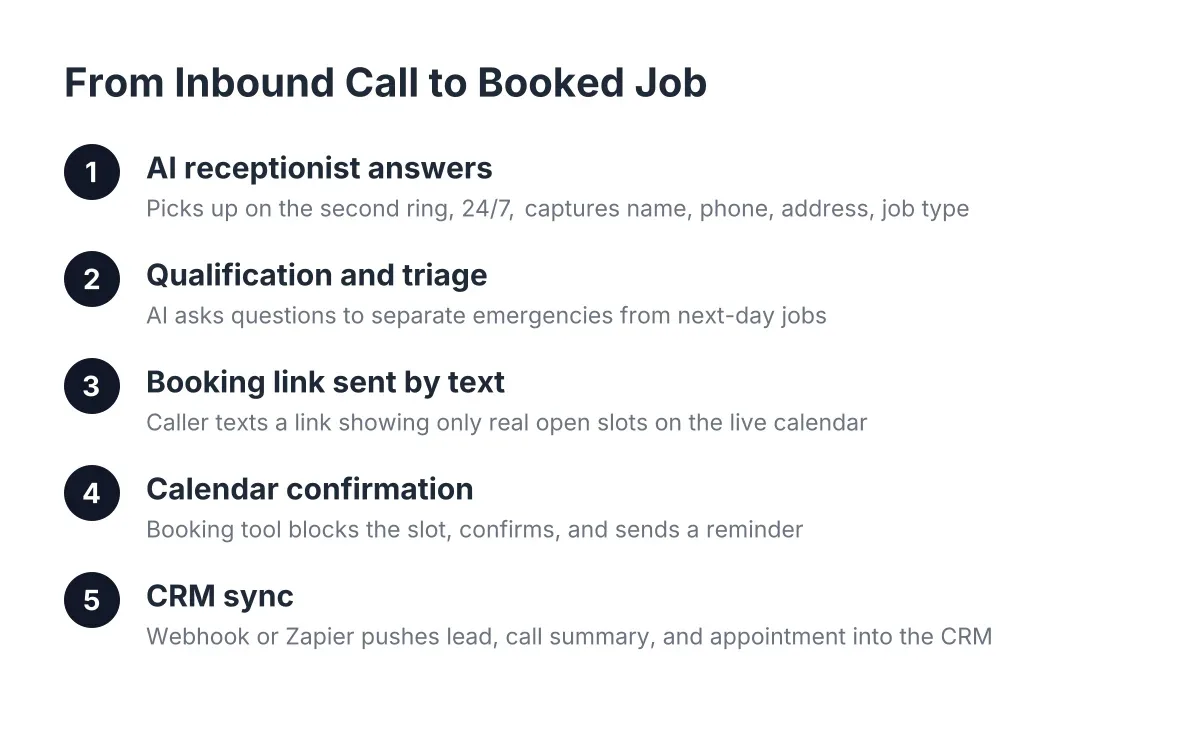
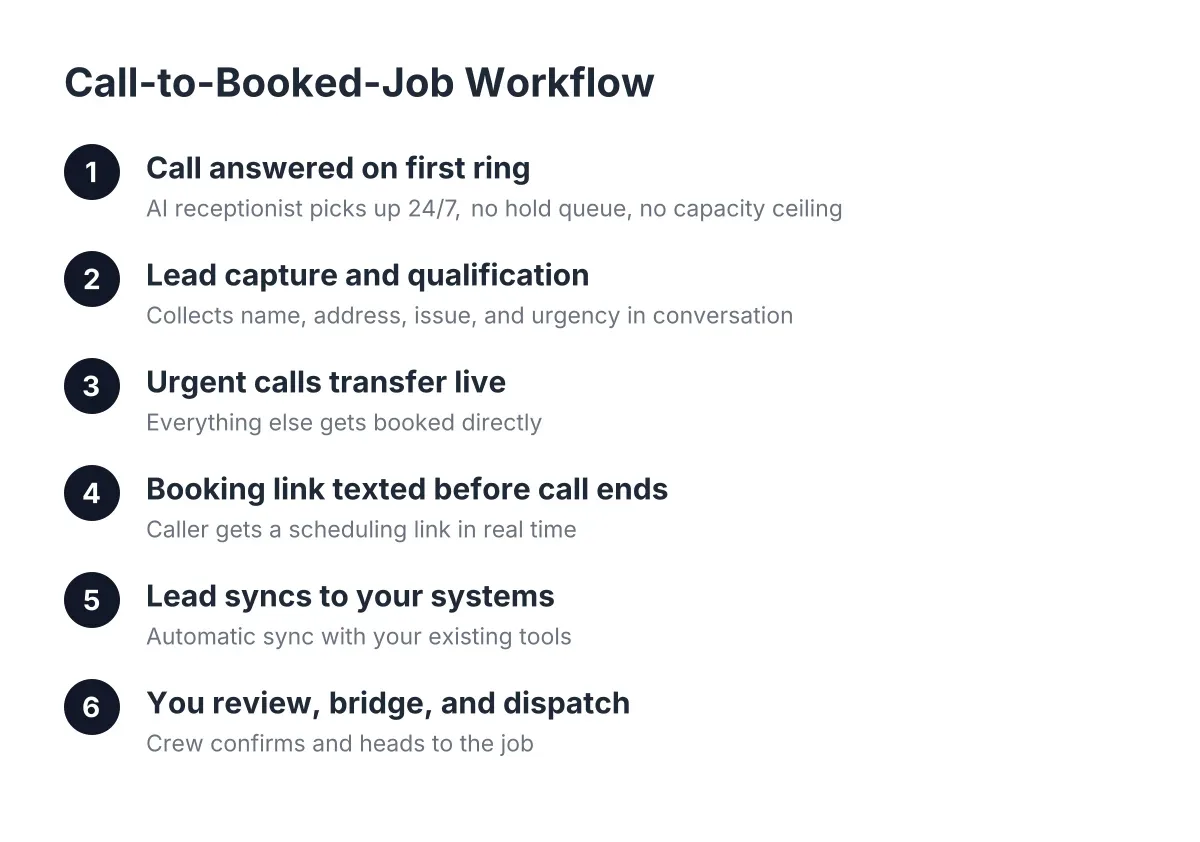
This is the promise of the article, so here is the exact path a call travels. No human scheduler in the loop, no phone tag, no callback list you work through at 9pm from your truck.
Step 1: The call gets answered on the first ring, every time
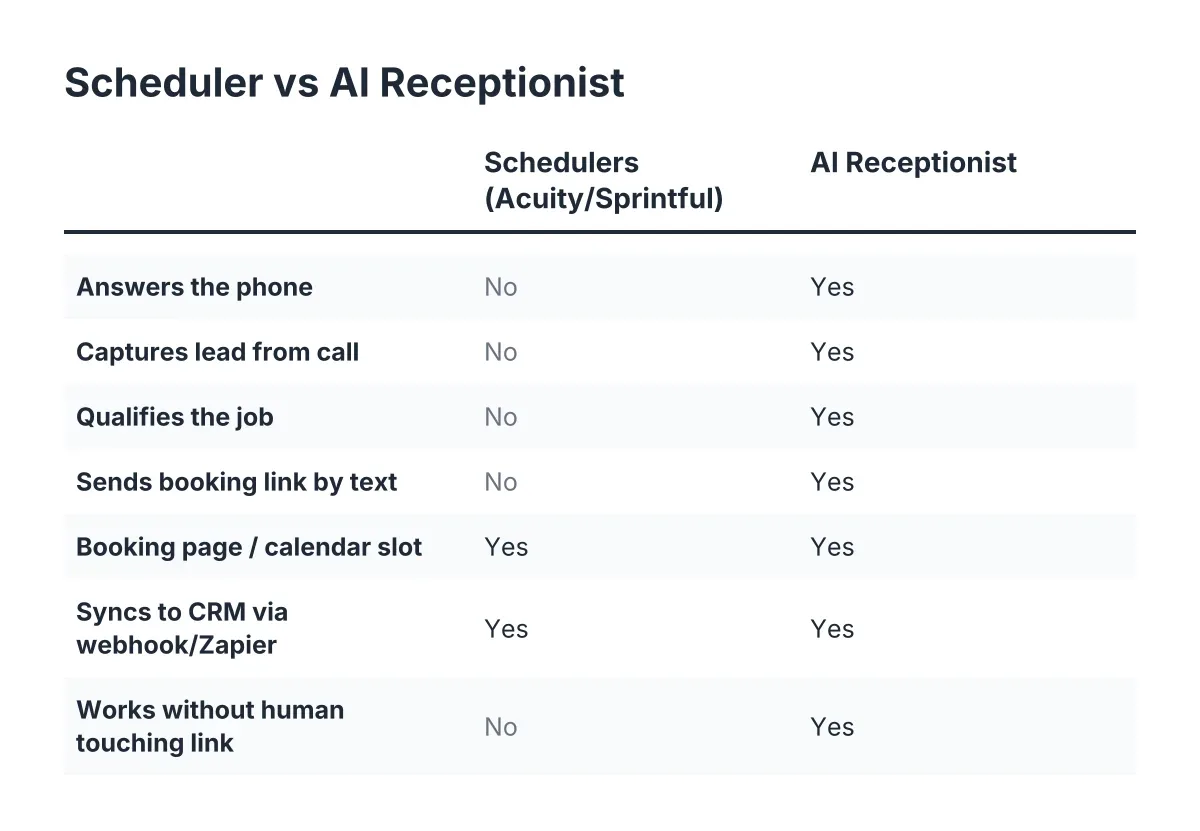
The AI receptionist picks up 24/7, in English or Spanish, based on how the caller responds. There is no hold queue and no capacity ceiling. During a storm spike, it handles the fortieth simultaneous call the same way it handles the first. That single capability is what separates it from both a human office lead and a national answering service that puts callers on hold when their board lights up.
Step 2: Lead capture and qualification happen in the conversation
The AI collects the details you would ask for yourself: name, callback number, service address, what is happening, and how bad it is. For an emergency trade this is triage. "Is water actively flowing?" "Do you smell burning?" "When did the AC stop cooling?" The answers get scored, so a no-cool call in 95 degree August heat with an elderly resident reads differently than a routine maintenance request.
Step 3: Urgent calls transfer live; everything else gets booked
If you have opted into live transfer, a true emergency bridges straight to your cell while the AI keeps the caller calm and on the line. For everything below the emergency threshold, the AI moves to booking.
Step 4: The booking link lands by text before the call ends
This is the step that removes the scheduling bottleneck. The AI texts the caller a booking link showing your real availability. The homeowner picks a slot on their phone while the details are fresh and the panic is subsiding. No "I'll call you back to schedule." No three-day text thread. The job is booked before they have a chance to shop the next company.
Step 5: The lead syncs to your systems automatically
Through webhooks and CRM sync with Zapier, HubSpot, Salesforce, or Zoho, the lead lands wherever you run your business. The call gets summarized and scored, so when you check your phone between jobs you see "burst supply line, water off, booked Thursday 8am, high urgency" instead of a voicemail you have to replay twice over jobsite noise.
Step 6: You review, bridge, and dispatch
From the dashboard, one click calls the lead back if you want to talk before the appointment. Every Monday morning a report shows what came in, what got booked, and what needs a follow-up. That report is also where your ROI stops being theoretical; you can count the after-hours bookings line by line.
The same workflow runs on your website. An AI website chatbot catches the visitor comparing three roofers at midnight, captures the lead, and delivers the same booking link. Two front doors, one calendar.
Can You Automate Appointment Setting for an Emergency Trade?
Yes, you can automate appointment setting for an emergency trade, with one critical design requirement: the system must triage before it books. Routine calls flow to a booking link and a calendar slot; genuine emergencies flow to a live transfer or immediate dispatch. When emergency call answering automation treats a flooding kitchen like a Tuesday estimate request, it will cost you jobs and trust.
The triage logic is what makes this work for urgent services specifically. A generic booking tool asks "What time works for you?" An AI receptionist built for trades asks "Is water still coming in?" first. That distinction is the difference between a homeowner who feels heard and a panic caller who hangs up and dials the next Google result.
Here is where appointment booking automation earns its keep across the whole spectrum of your call volume. The 2am burst pipe transfers to you live. The "my water heater is making noise" call books itself into Thursday's open slot. Additionally, the Spanish-speaking caller in Pflugerville gets qualified and booked in Spanish without a callback or a translator. You touched none of it, and all three ended up in the right place.
One honest limitation: an AI appointment booking bot handles intake, triage, and booking, but it does not diagnose. Complex jobs, multi-trade estimates, and insurance scope disputes still need your judgment on site or on the phone. The automation gets the right people onto your calendar; the expertise that closes a $7,500 restoration job is still yours. Treat it as a dispatcher that never sleeps, not a technician.
A Storm-Week Scenario: Counting Booked Jobs, Not Answered Calls
Suppose a hail storm rolls through Georgetown on a Wednesday evening. A typical roofing and restoration crew of eight technicians would see something like this over the next 72 hours.
Without automation: the office lead answers from 8am to 5pm and handles maybe six calls an hour with proper intake. Overnight calls hit voicemail. In that scenario, out of 220 inbound calls in three days, roughly 90 get answered, 60 get qualified, and 35 get booked before callers move on. The other 130 calls scatter across every competitor whose phone got picked up.
With the workflow above: all 220 calls get answered on the first ring, including the 3am calls from homeowners listening to water drip into their attic. Insurance details get captured during intake. High-urgency leads get scored to the top. Booking links go out by text while the caller is still motivated. If even 100 of those calls book inspections and a quarter of those convert at a $7,500 average, that is $187,500 in pipeline from one weather event. Against a monthly software cost measured in hundreds of dollars, the return from answered emergency calls in a storm week is not a percentage. It is a multiple.
The illustrative numbers will differ for your trade and your market. The structure of the math will not. Storm and event-driven businesses measure payback in days, not quarters, because the entire year's revenue can concentrate into a handful of 72-hour windows. Capacity during those windows is the whole game.
What Drives ROI Up or Down for AI Call Answering
Not every business gets the same return, and pretending otherwise would be a disservice. These factors move the number most:
- After-hours call share. The more of your volume lands nights and weekends, the bigger the recovered revenue. Emergency plumbers and restoration crews sit at the top of this curve.
- Average ticket size. At a $7,500 average job, one recovered booking a month is a blowout return. At a $150 average, you need volume to make the math sing, though the math still works.
- Volume spikes. If your demand arrives in storm-driven bursts, unlimited simultaneous answering is worth far more to you than to a business with flat, predictable call flow.
- Bilingual market. Central Texas has a large Spanish-speaking customer base. If your current setup loses those calls, answering in Spanish by default is a revenue line most trades have never measured.
- Your follow-through. Automation books the appointment. Showing up on time, quoting fairly, and doing good work still converts the booking into revenue and the customer into a recurring one. No software changes that.
One more factor worth naming: what you are not spending. According to the National Federation of Independent Business, 98 percent of small employers using AI reported no change in employee headcount. That matches how this plays out in the trades. The AI receptionist does not replace your office lead or your relationship with customers. It answers the calls that were going to voicemail anyway, and it frees whoever runs your office to handle the work that needs a human.
There is also a timing edge. The same NFIB survey found only 24 percent of small employers currently use AI tools at all. In a market where three roofers bid every storm-damaged street, being the one whose phone answers on the first ring at 2am is a competitive gap most of your rivals have not closed yet.
How to Measure the ROI of AI Call Answering in Your First 30 Days
Measure the return from emergency call answering by tracking three numbers from day one: after-hours calls answered, appointments booked without human involvement, and revenue from those booked jobs. Compare that revenue against your monthly cost. Most emergency trades see the comparison settle within the first two to four weeks.
Set up the measurement before you need it:
- Baseline your missed calls now. Screenshot your last 90 days of phone records. You cannot prove recovery without a before picture.
- Tag automation-booked jobs in your CRM. The webhook sync makes this easy; every lead that arrives through the AI receptionist carries its source. Do not let these jobs blend into general revenue.
- Read the Monday morning report. It lists calls answered, leads captured, and appointments booked from the prior week. Ten minutes with coffee, once a week, is the entire reporting burden.
- Track after-hours bookings separately. These are the purest measure of recovered revenue, because before automation your answer rate on them was zero.
- Watch call scores against outcomes. If high-urgency scores consistently turn into your best jobs, tighten your dispatch rules around them. The intelligence layer improves as you feed it your real results.
After 30 days you will have a number, not a guess. Divide recovered revenue by cost. For a trade with real after-hours demand, that ratio typically lands somewhere between uncomfortable-to-say-out-loud and why-did-I-wait.
The Bottom Line: Booked Jobs Are the Only Metric That Matters
Answered calls are a vanity metric. Captured leads are a step closer. Booked jobs on your calendar, confirmed while you were on site with a wrench in your hand, are the number that pays for trucks and payroll.
The workflow in this guide, first-ring answer, bilingual qualification, triage, booking link by text, CRM sync, and a Monday report, exists to maximize exactly that number. It runs at 2pm on a slow Tuesday and at 2am after a Georgetown hail storm, at the same cost, with the same calm voice.
If you want to pressure-test the claim, do what a skeptical trade owner should: call the AI yourself. Play the panicked homeowner with a flooding kitchen. Switch to Spanish mid-call. Try to stump it. Then check whether a booking link hits your phone before you hang up. That sixty-second test will tell you more about the return than any calculator, because the return was never abstract. It was always the next call you could not answer, finally landing on your calendar instead of your competitor's.
If you're losing revenue to missed calls, NeverMiss ATX can help.
Prefer to talk it through? Call (512) 980-9267 — a quick call is usually the fastest way to get a straight answer for your situation.